

House Insulation: Energy Savings + Ideal Climate
The ideal period for house insulation and its subsequent implementation is during the spring and summer months. In warm and dry weather, construction materials dry out excellently. This way, you can prepare for the upcoming winter well in advance, without the stress of time pressure. We have prepared an overview of various insulation types, including a summary of materials available on the market. Put a stop to heat loss and the intrusion of winter into your home. Save energy and reduce noise levels from the surroundings.
Types of Insulation
Insulation is divided into external and internal, depending on where the insulation is applied. The recommended thickness depends on the thermal-insulation quality of the underlying masonry and usually ranges between 140 and 180 mm. Passive houses can have insulation thickness of up to 300 mm.
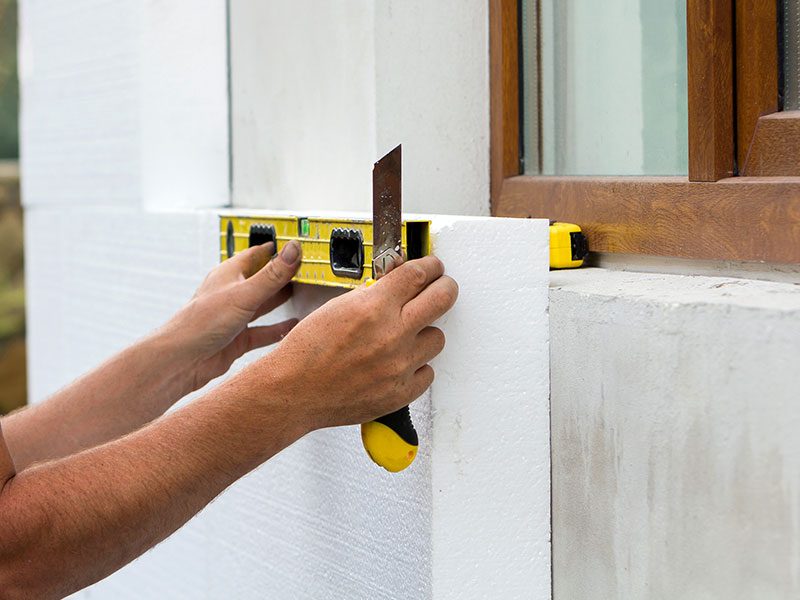
External - Insulation is adhered to the exterior of the building. It is more efficient and easier to install. In most cases, insulation is directly applied and anchored to the façade using anchors.
Internal - Insulation is installed on the interior part of the structure. This is the case when the building is, for example, a heritage site or when alternative installation methods are not feasible. Prior to insulation installation, it is necessary to inspect the condition of the building, including the walls.
What materials are used for insulation?
→ Synthetic Materials
Polystyrene - Polystyrene, also known as EPS, is the most commonly used material for construction insulation, and it has a very favorable price. There is a wide variety of types, shapes, and surfaces available on the market. The most common types are white and gray graphite polystyrene, used for façade insulation. Extruded polystyrene is used for floor and roof insulation, while perimeter polystyrene is used for basements and foundations.
Sprayed or poured polyurethane foam - Polyurethane foam insulation is organic-based and adheres to any surface, making it highly versatile. It is applied by spraying or pouring and expands its volume multiple times over time. The foam fills all gaps and irregularities and provides excellent insulation. Polyurethane foam is safe and does not contain any hazardous components.
PIR (Polyisocyanurate) - An improved form of PUR insulation. It has better insulation properties and meets higher fire safety requirements than PUR foam. Its low weight guarantees easy installation and handling.
Phenolic foam - Expanded phenol-formaldehyde resin produced in block form. The boards are subsequently coated on both sides with fabric, polystyrene, or aluminum foil. It stands out for its low weight and good thermal insulation properties.
→ Natural and Ecological Materials
Mineral wool - Non-combustible and environmentally friendly insulation. It has excellent sound and thermal insulation properties, including vapor permeability. There are two types of mineral wool, differing only in the material used for production.
- Glass wool - Contains sand and recycled glass, excelling in sound insulation and good fire safety.
- Stone wool - Manufactured from volcanic rock, primarily basalt, dolomite, and diabase.
Hemp insulation - Insulation made from hemp in the form of hemp mats. It has excellent thermal and sound insulation properties and exceptional moisture regulation capabilities. It is suitable for insulating roofs, walls, and floors. It does not contain allergens or other harmful substances.
Cellulose - Insulation made from crushed or ground newspapers. The disadvantage is the flammability of the material and its moisture absorption. On the other hand, its eco-friendliness and easy recyclability are positive aspects.
Wood fiber - It is used in the form of wood fiber boards, primarily for insulation of floors and exterior walls in timber constructions. However, its price is higher, so it is used minimally.
Straw - This technology is very rarely used. The installation is more challenging, and the material is highly flammable, which poses safety risks. However, it is an eco-friendly option.
Sheep wool - Wool is particularly suitable for insulating joints in log cabins and timber-framed houses. It has excellent thermal insulation properties but is rarely used.
Where to draw inspiration?
You can find inspiration about housing and interiors in magazines such as Dolce Vita, Elle Decoration and others.
Also, at trade fairs. Excellent ones are For Interior and Designblok in Prague, Mobitex in Brno. On the social network Pinterest, where you can find plenty of original ideas.
Regardless of which option you choose, we recommend hiring a construction company for the installation. Doing the insulation yourself is very time-consuming and may not meet the expected properties.
We would be happy to guide you in choosing the right insulation for your property and provide advice on options tailored to your real estate.
Contact us, and we will assist you. Yours, MURA.
You can also follow our work on Instagram.

